Copy and UX Writer, Xfinity
Led and supported copy, messaging strategy, and UX for Xfinity customers on Comcast’s Lifecycle Marketing & Strategy team.
COVID-19 messaging and UX strategy
Writer on Xfinity’s service communications and UX emergency efforts through COVID-19
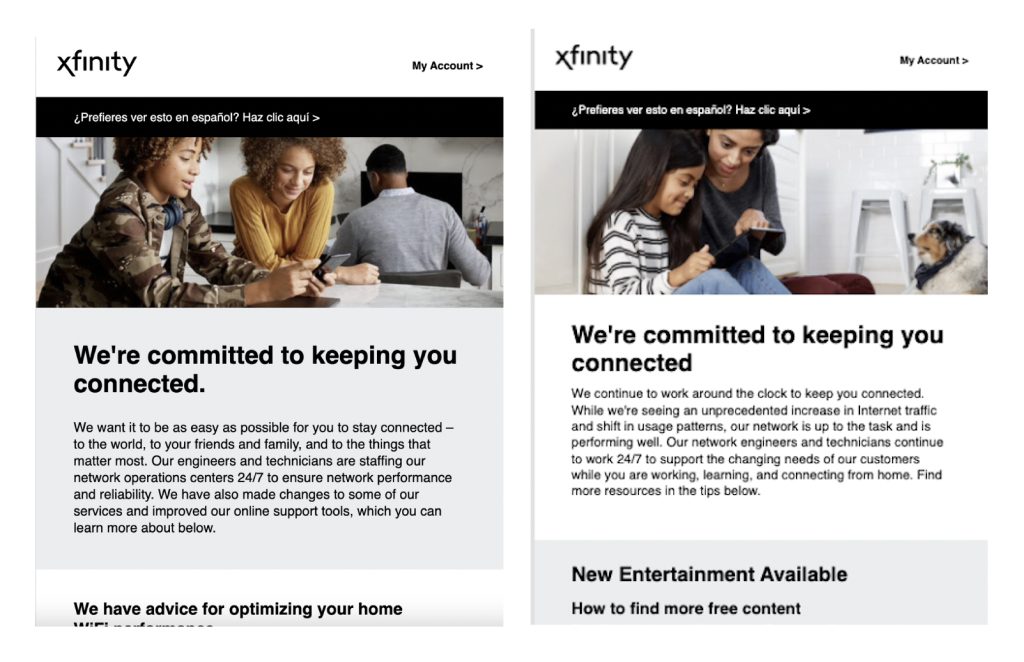
The problem: As the pandemic began, our service communications team needed to let customers know how we were responding and how it affected them—in real time, as the decisions were being made. Xfinity and Comcast needed to build an extensive and thorough communication strategy. How could we could help our customers by making sure our WiFi networks could support work and school from home, and how we could keep people connected who may have experienced financial hardship?
-
There were so many moving parts, and we needed to coordinate with product teams and PR simultaneously to keep messaging consistent and information available. Customers needed to understand we would do everything possible to keep them connected, informed, and even entertained.
This meant staying connected with them, too, through continual service messages.
-
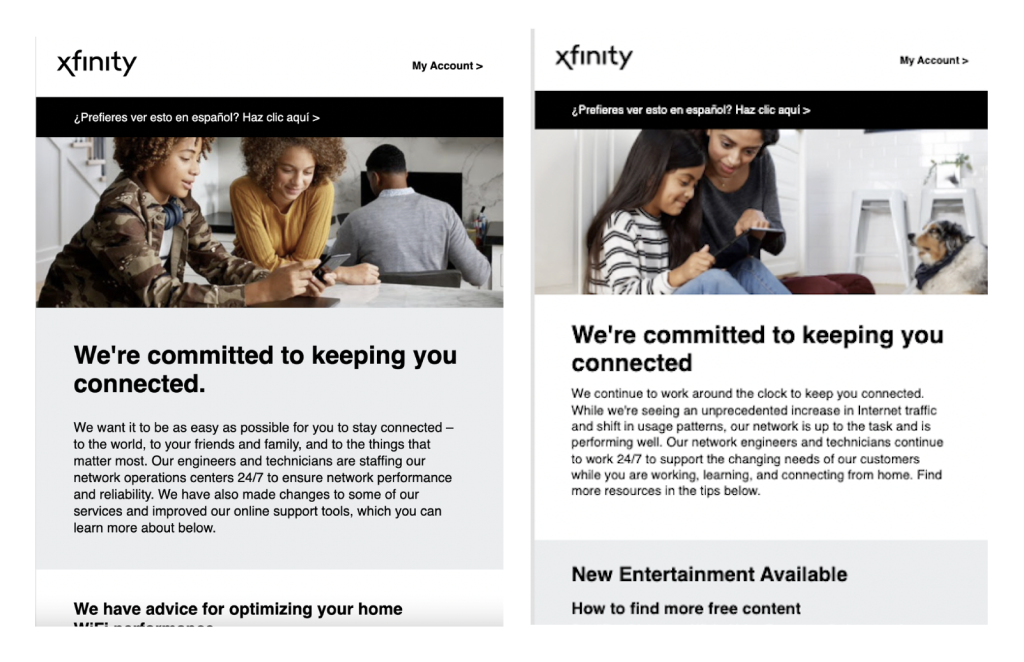
These are just two samples of the many dozens of communications that belonged to multiple coordinated campaigns. I wrote emails, web updates, My Account messages, text messages, push notifications, in-app and in-product messages, TV alerts, IVR messages for our retail stores, and more.
-
Amid the scramble to put together emergency strategies for a worldwide pandemic, all of us suddenly working from home, too. We were building the plane while we were flying it, like every other company at the time. This process went from scrappy to efficient quickly as we got used to the daily updates and communications to customers as the situation progressed. One of Xfinity’s issues was that it was extremely siloed, but we needed to find a solution to centralize all our messaging for our retail customers. Out of necessity, these extenuating circumstances solidified a UX strategy for service communications that we had been missing.

The Hub takeover during COVID-19
UX and FAQ writer on Xfinity’s real-time messaging during the pandemic. Xfinity’s Hub website became home base.
The problem: At the start of the pandemic, we had so many critical messages and no established central location to put them. Xfinity and Comcast relied more heavily on individual communications for emergency service messaging. Suddenly we needed a home base for all our emergency resources so users could stay connected. It was more than just another bill. WiFi and phone connectivity was a lifeline.
-
The Xfinity Hub was the natural choice for this, but we needed to change the character of the site immediately and entirely. It became the home for COVID-related news, service FAQs, and emergency resources.
-
I created lots of FAQs; researched complications customers may have been experiencing; worked across the organization with retail stores, Xfinity Mobile, and our xFi app team. I collaborated with the Xfinity Brand team to start establishing emergency language content guidelines.
-
We were all reaching across the aisles to coordinate an incredible volume of messaging and customer resource strategies. We connected users with ways they could get re-connected to WiFi if they had experienced a shut-off, and we paused any connection interruptions. We made sure kids had WiFi to learn from home while schools were closed, and we flexed to meet unprecedented WiFi demands for work from home.

The how-tos
Writer and content strategist on product, service, and billing FAQs for Xfinity’s Hub.
The project: Cable, internet, and all the hardware that comes with them can be extremely confusing. How to set up your new TV box, how WiFi mesh extenders work, how to set up your streaming services on your smart TV. There’s no shortage of complicated and technical tasks we asked of our customers. Our robust FAQ website was always in need of updating as we constantly introduced new products and services. And if we couldn’t keep up with questions customers were asking, they’d end up on third-party websites (aka Reddit) looking for help. Not only would we lose website traffic, we’d make the customer even more frustrated.
-
My team and I wrote customer support articles that were a collaboration between service communications, marketing, engagement, and customer support. And we had to make ourselves SMEs on these topics to ensure the FAQs were not only easy to follow, but also correct. This meant reaching across teams and to different parts of the business to fact-check and troubleshoot the equipment ourselves.
Examples of articles:
- Equipment troubleshooting
- Channel lineup changes
- How to improve your Internet speeds
- How to sign up for paperless bills
- Explanations of taxes and fees on your bill -
With these articles we featured new and exciting benefits of our products and services. We also addressed commonly searched questions about products and services that were showing up in external, non-Comcast websites. We kept more traffic on our site and provided customers a source of truth directly from the source.
Hey, we actually have good news!
Writer and content strategist for service-related emails and in-app messaging for feel-good messaging.
The project: Most of the service communications you’ll get from your utility companies are either neutral or frustrating. Bills, service interruptions, etc. When Xfinity had good news to share, we really wanted to shout it from the top of the Comcast building.
-
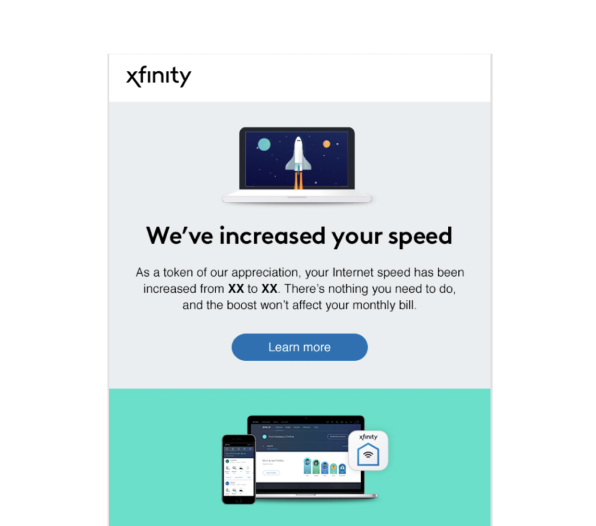
We did something unexpected for some of our customers. Surprise! Spontaneous faster internet speeds at no extra cost! This was big news, and we really wanted to reassure customers they wouldn’t be charged more. It was a great opportunity to win some customer trust and good will, and to reinforce that we do provide the best service.
-
To amplify the good news, we co-promoted faster speeds with another free benefit: the free xFi app. Collaborating with the Engagement team, we wanted to create excitement around faster and more secure Internet. I created emails and coordinated in-app messages, push notifications, and text messages promoting faster speeds + the xFi app, all at no added cost.
-
By blending UX and customer engagement with service communications to tell customers a whole story, we were able to elevate our creative and streamline our messaging.

OK, back to the not-so-good news
Lead writer year after year on Xfinity’s price change email and coordinating communications. Trusted by executive leadership to strategize and manage the writing, editing, and approval workflow of this high-stakes project.
The problem: Every year, we needed to let retail customers know their prices would be increasing. And every year I worked with Xfinity, I was the dedicated writer for this suite of communications, which went to each Xfinity retail customer in the US. How do you find new and creative ways to communicate (and spin) price increases and get every executive in the organization to approve it?
-
A notorious bad-news message, annual price change was part notification and part customer education. I needed to explain what was happening, how it affected customers, and why it was happening. Ultimately, we wanted to remind customers why their services were worth the price increase.
Messaging was under a lot of scrutiny from leadership at every level, from product teams to PR to the president of consumer services. Each year, we’d go through more than 30 rounds of revisions before we’d settle on a final.
Annual price change demanded a mastery of version control and coordination. It turns out this is my superpower, which is why I was the one trusted to own these communications.
It required:
- Print letters delivered to all retail customers at least 30 days before the price change. But it wasn’t just one version of the letter. We created up to 8 versions with slightly different messaging according to customer location, service tiers, and state regulations.
- Emails that corresponded to the letters
- Bill messages in customers’ statements for months surrounding the price change
- Channel lineup cards sent to all TV customers
- Text messages and push notifications sending customers to view their account
- My Account banners and alerts in customers’ online portals -
Sadly, the result for customers is that they had to pay more.
There’s no easy way to deliver news about a price increase. While I wish it didn’t need to happen, I’m proud of the work we did here to empathize and be transparent with customers. I was very invested in this project’s message. Flowing 30+ rounds of edits into 8 different versions of a letter and all the other notifications would keep me very busy every year. But it’s nice to be trusted with such high-stakes work.